
Haremeyn: Makkah al Mukarramah and al Madinah al Munawarrah in Photographs from the Ottoman Period
Malaysia’s National Visual Art Gallery currently holds an exhibition entitled Haremeyn: Makkah al Mukarramah and al Madinah al Munawarrah in Photographs from the Ottoman Period from 12 June 2015 until 30 September 2015 at Gallery REKA, National Visual Arts Gallery, held in conjunction with the arrival of Ramadhan (Muslim fasting month) that begins on 18 June 2015 until 16 July 2015.
No other sites in the world are considered to be more holy and sacred in Islam than the landmarks in humanity’s sphere of faith and worship, which are the Kaaba (Masjid al Haram) in Makkah al Mukarramah and Masjid al Nabawi in al Madinah al Munawarrah. For this reason, Makkah and Madinah have an inestimable place in the hearts of Muslims.
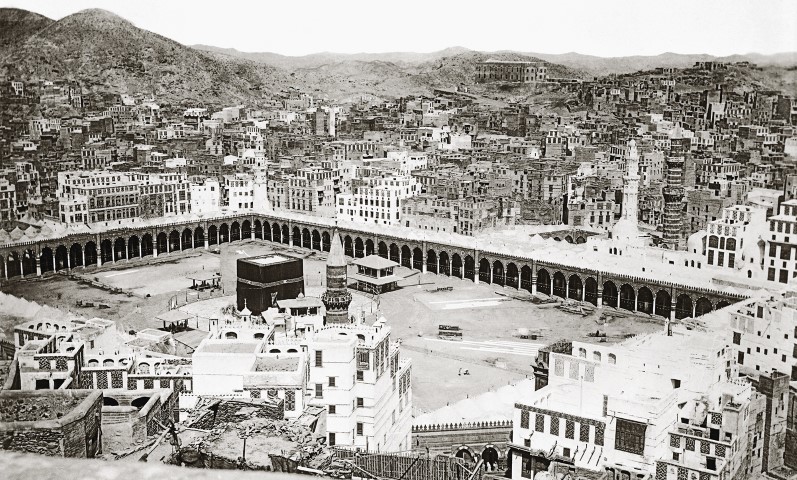
One of the photographs from the Haremeyn exhibition: Al-Haram Al-Sharif, Al-Kaaba Al-Muazzama and the surrounding houses as seen from Abu Qubais Mountain
Makkah and Madinah are specifically safeguarded by Islamic jurisprudence and considered to be “harem” (sacred) and are called “haremeyn”, meaning sacred cities. They were where the Holy Qur’an was revealed and the originating points of the Islamic faith’s history and civilisation, besides being the locations where Prophet Muhammad (p.b.u.h) spent his worldly days. They are maintained not only as places of worship, but also as sources of inspiration and invaluable heritage of the Islamic civilisation.
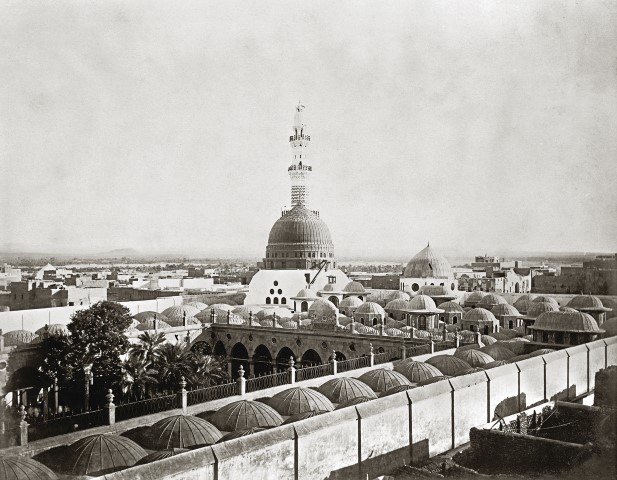
Al-Masjid Al-Nabawi And Al-Qubbat Al-Khadra in Madinah
In support of this effort, the National Visual Arts Development Board (NVADB) in cooperation with IRCICA, a body established under the Organisation of Islamic Cooperation (OIC), is currently presenting an exhibition of rare photographs that record various events that took place in Makkah and Madinah during the Ottoman rule.
The photographs offer the audience the bucolic glimpse of how both holy cities looked like prior to massive modernisation and development, including the conditions that pilgrims of the past had to endure when performing Hajj and Umrah, which strike a chord among present day pilgrims. Holy Islamic vestiges such as the domes the cover the cemetery of Prophet Muhammad’s immediate family members and companions in Madinah that had been demolished could also be seen in the images displayed.
The photographs exhibited are selected from the collection of Sultan Abdulhamid II (r. 1876 – 1909), the 34th Sultan of the Ottoman Empire who was also known as “The Great Khan”, and from the collection of Fahreddin Pasha (1868 – 1948), the Commander of the Ottoman Army and Governor of Madinah, also known as “The Lion of the Desert.” Some of these exhibits have been preserved and maintained by IRCICA, which is involved in research, publication, archives and documentation on Islamic history, culture and civilisation.
Among the photographs being displayed is the “Al Haram Al Sharif” taken during the Hajj season of 1297/1880 by Colonel Mehmed Sadik who saw a group of Ottoman soldiers taking photographs and recording the topographical environment of Makkah, Madinah and Taif in order to provide a sketch map of the cities and the streets. As a result, a map of Makkah was able to be successfully created a few months later, in Rabi al Waal 1298/ March 1881. More remarkably rare photographs showing a number of other important and interesting events are also on display.
The public is invited to attend the exhibition and learn more about the historiography of these holy sites specifically during the reign of the Ottoman Empire. Visitors also can see the development and changes made by the Ottoman government to uphold these two holy cities and meet the needs of visitors especially during the Hajj season, without changing the original condition of the cities.
Another element of the exhibition includes the chance for the public to share their moments in Makkah and Madinah. A special Facebook page called “Haremeyn – Kota Suci Mekah Dan Madinah” have been set up to allow members of the public to share their experiences performing Umrah or Hajj. They are welcome to upload their photos onto the Facebook page to inspire more people to visit these cities. The uploaded photos would also be featured on the screen throughout the exhibition.
For more information, contact +6 03 4026 7000 or visit www.artgallery.gov.my.
About The Author


Juhan Kamaruddin has spent years sharing and editing stories that inspire people to explore the world with greater curiosity and purpose. Passionate about travel, culture, and meaningful connections, he works closely with tourism stakeholders, media partners, and industry leaders to showcase the best of Malaysia and beyond through storytelling, strategic content, and collaborative partnerships.


Leave a Reply